
Every domain sale tells a story.
From the outside, a transaction can look deceptively simple: a buyer makes an offer, the seller accepts, and the domain changes hands. But behind many aftermarket domain sales is a short chain of negotiations, decisions, and operational steps that must proceed smoothly for both parties.
Recently, a domain listed with Efty.com, Trive.ai, was sold for $16,500. What makes this transaction interesting is not just the price, but how efficiently the entire process unfolded: from buyer payment to seller payout in under 24 hours.
Here’s how the deal came together.
Anchoring the Price
The domain was listed with a Buy-It-Now price of $19,000, while still allowing buyers to submit offers.
This pricing structure is intentional. In the domain aftermarket, the BIN price often acts as an anchor rather than a strict expectation. A higher BIN serves as a reference point for negotiation and signals the perceived strategic value of the name.
As I discussed in this thread on domain pricing strategy on X, setting a strong anchor helps shape buyer behavior. When a buyer sees a meaningful price attached to a domain, it frames the negotiation from the start and signals that the name is positioned as a premium asset.
The Opening Offer
On January 14, an offer arrived through the domain’s Efty For-Sale landing page.
The buyer opened with $15,000.
This is a common negotiation pattern when a domain has both a BIN price and a Make Offer option enabled. Buyers who are comfortable paying the full BIN typically purchase the domain instantly. But when they believe there may be room to negotiate, they’ll often start with an offer below the asking price to test the seller’s flexibility.
Even when buyers choose to negotiate, the BIN price still does its job. It sets the anchor for the discussion and helps keep negotiations within a realistic range.
Closing the Deal
The seller responded with a counteroffer of $17,000, signaling flexibility while still staying close to the original asking price.
The buyer quickly returned with an offer of $16,500.
At that point, the two sides were already very close. As is often the case in domain negotiations, the deal closed within a narrow range between the buyer’s opening offer and the seller’s counteroffer.
Once the price was agreed, the seller initiated the transaction through Efty Pay, sending the buyer a secure checkout link to complete the purchase.
A smooth checkout experience is critical at this stage. Even when a buyer has agreed to the price, friction can kill deals. Efty Pay is designed to remove as much of that friction as possible. Buyers are not required to go through KYC, which keeps the process fast and straightforward. They can pay with major credit cards, including American Express, a favorite among corporate buyers, as well as PayPal, with high limits up to $23,000.
If buyers have questions or concerns during checkout, live chat support is available directly within the payment flow to guide them through the process and ensure a smooth transaction.
Payment and Transfer
The buyer completed checkout shortly after receiving the secure payment link.
Within hours, the payment was received and approved. At that point, the seller’s job is pretty much done.
Instead of transferring the domain directly to the buyer, the seller only needs to deliver the domain to Efty Pay’s holding account.
Efty Pay maintains holding accounts with all major registrars, making this process quick and straightforward. In most cases, sellers can simply push the domain to Efty Pay’s account at the same registrar, avoiding delays that can sometimes occur with inter-registrar transfers.
This also means that even if a domain is still locked, sellers can push it internally to Efty Pay without waiting for the transfer lock to expire, helping keep the transaction moving smoothly once a deal is agreed.
Once the domain arrived in the holding account and ownership was confirmed, the transaction moved to the final stage: releasing the seller’s payout.
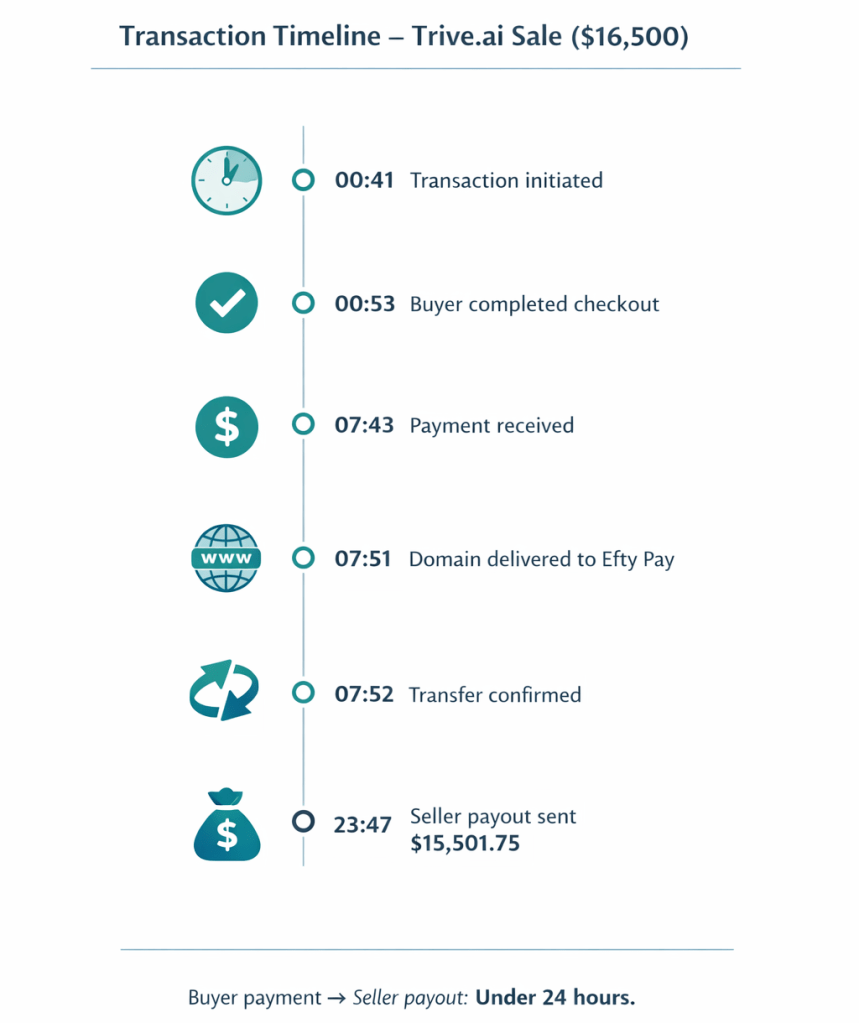
Seller Payout
Once the domain name was delivered into Efty Pay’s holding account, the final step was releasing the seller’s payout.
The domain sold for $16,500, and after Efty Pay’s industry-low 5% commission, the seller received $15,501.75
From the moment the buyer completed checkout to the moment the payout was sent, the entire process took less than 24 hours .
For domain investors, the economics of a sale matter just as much as the speed of the transaction. Lower commissions mean sellers keep more of the value they’ve created while still benefiting from a secure, streamlined transaction process.
Why Transaction Speed Matters
Selling a domain can often take years, from the moment it’s listed to the moment the right buyer appears.
And when that buyer commits, the closing process should move quickly.
Fast transactions reduce uncertainty for both buyers and sellers. They also allow domain investors to recycle capital more efficiently into new acquisitions and opportunities.
Behind every domain sale is a sequence of small steps that bring the deal across the finish line.
And when those steps happen quickly and securely, the entire experience becomes easier for everyone involved.
If you’re a domain investor looking to streamline your sales process, you can start using Efty Pay in two ways. Sellers who want a complete portfolio management and sales platform can sign up for Efty Investor, which includes Efty Pay built directly into its for-sale landing pages and domain shop feature.
Alternatively, if you already manage your domains elsewhere, you can create a standalone Efty Pay account and use it to import any Buy It Now or Lease to Own deals you’ve already negotiated.

 Efty Blog